

Markos Anagnostakos holds a Bachelor’s degree in Materials Science from the University of Patras and is currently pursuing a Master’s degree in Chemistry at the same university. Within the GRAPHERGIA project, he works at the Institute of Chemical Engineering Sciences (FORTH/ICE-HT), the project coordinator, where his research focuses on graphene fabrication techniques for energy storage and harvesting applications.
His work explores the direct growth of graphene-based structures on textiles using laser irradiation. The approach aims to create flexible, conductive structures directly on textile substrates, thereby enabling the development of next-generation energy-harvesting and storage devices.
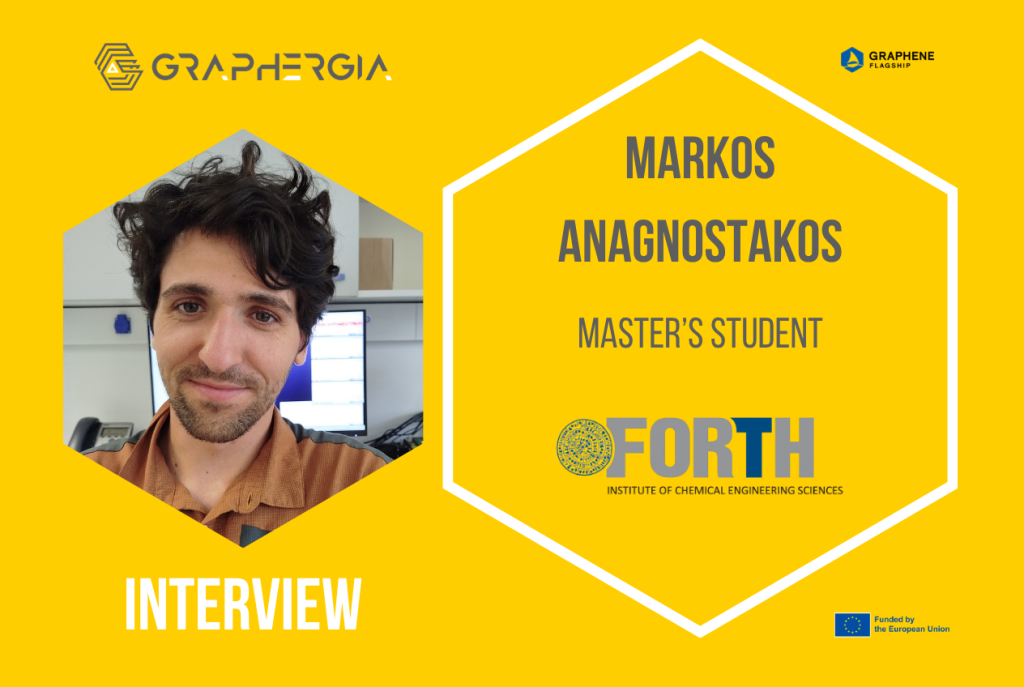
”My vision for graphene and 2D materials is centred on finding practical alternatives and creating targeted solutions to our current energy dependencies” – Markos Anagnostakos, Early-Career Researcher at FORTH/ICE-HT.
Can you briefly describe your research and how it fits into the overall GRAPHERGIA project? What specific problem are you trying to solve with your work on graphene?
My research primarily investigates the direct growth of graphene-based structures on textiles, for flexible energy harvesting and storage devices. More specifically, I am focusing on in situ graphene synthesis via laser irradiation of deposited precursor materials on the textile. From GRAPHERGIA’s perspective, my research aligns perfectly with WP2: Design, development and optimisation of textile-based TENGs and micro-flexible SCs. With the above-mentioned method, we are shifting from the chemical and challenging synthesis of conductive materials to a cost-effective, environmentally friendly, human-friendly, scalable, and industrially applicable synthesis of flexible, conductive graphene structures. Lastly, biomass-based materials could be used as precursors, expanding the range of available materials.
What are the main challenges you face in working with graphene at a practical level?
One of the main challenges is bridging the gap between the theoretical properties of graphene-based materials and their performance in real-world applications. When integrating conductive materials into textiles, we need to achieve high electrical conductivity without compromising the textile’s flexibility or structural integrity. Finding the right balance between these properties, the appropriate optimisation window, is therefore a complex task.
How do you collaborate with other teams within the GRAPHERGIA project?
Collaboration within the GRAPHERGIA consortium is excellent. I work closely with partners who provide the textile substrates needed for my experiments. Beyond exchanging materials, there is a continuous exchange of knowledge and expertise between partners. This helps ensure that my research remains both scientifically robust and relevant to industrial requirements, while contributing to the common objectives of GRAPHERGIA.
How has being part of GRAPHERGIA shaped your academic or career path so far?
Being part of GRAPHERGIA has been incredibly helpful for my career path. The most significant impact has been firsthand experience with the operation of a large-scale collaboration among different partners. Learning to communicate and contribute within such a multidisciplinary environment is a vital skill for an early-career researcher.
How does your research contribute to sustainable energy solutions?
I see textile-based energy devices as a potential sustainable alternative to conventional batteries for small-scale applications with relatively low energy requirements. By developing flexible devices and integrating energy harvesting and storage directly into textiles, we can significantly reduce our reliance on traditional, less eco-friendly battery materials for everyday wearables and small electronics. This shift provides a practical pathway to reducing electronic waste and focusing on more environmentally friendly materials.
As GRAPHERGIA is in its third year of research, are there any early results or developments that have particularly excited you?
At this stage, one of the things that excites me most is the fundamental knowledge I have gained about the complex fields of energy harvesting and energy storage. Understanding how these two mechanisms can be combined and optimised within a single flexible device has been a major personal breakthrough.
I am also excited by the combination of expertise across the GRAPHERGIA consortium and how the partners’ complementary contributions are coming together to develop such a device. This will be demonstrated through GRAPHERGIA Demo Case #1, the all-in-one self-charging textile.
How do you see graphene and other 2D materials transforming the future of energy in Europe over the next 10–20 years?
My vision for graphene and 2D materials is centred on finding practical alternatives and targeted solutions to our current energy dependencies. I do not view energy harvesting as the solution to the current energy crisis, nor do I believe that it should be used to sustain a high-energy-dependent lifestyle. Instead, over the next 10 to 20 years, I see these materials as a crucial part of an important systemic shift. By providing sustainable and localised alternatives, such as replacing toxic and wasteful batteries in essential, small-scale applications, 2D materials could serve as a tool for mitigating a much broader environmental problem.
Follow us on LinkedIn, X, BlueSky and YouTube to discover more about GRAPHERGIA and read more interviews like Markos’!