

In GRAPHERGIA, we develop graphene-based technologies to harvest and store energy in everyday materials and demanding environments, from smart textiles to space.
Spacecraft and satellites need power systems that are light, robust, and reliable under conditions few devices on Earth ever face: vacuum, extreme vibration, and high mechanical loads. Supercapacitors (SCs) have recently emerged as promising power management solutions for space applications, from CubeSats and Very Low Earth Orbit (VLEO) satellites to electromechanical thrust vector actuation and interplanetary devices. Their wider adoption, however, is still limited by lower energy density than lithium-ion batteries (LIBs) and high self-discharge rates.
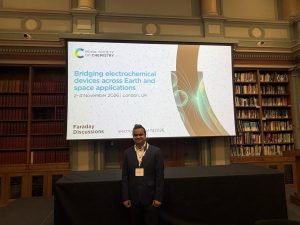
This challenge was at the heart of the Faraday Discussion “Bridging electrochemical devices across Earth and space applications”, organised by the Royal Society of Chemistry (RSC) at Burlington House, London, UK. From 2 to 4 November 2026, the event brought researchers and industry together to discuss how electrochemical devices developed for use on Earth can meet space needs, and vice versa.
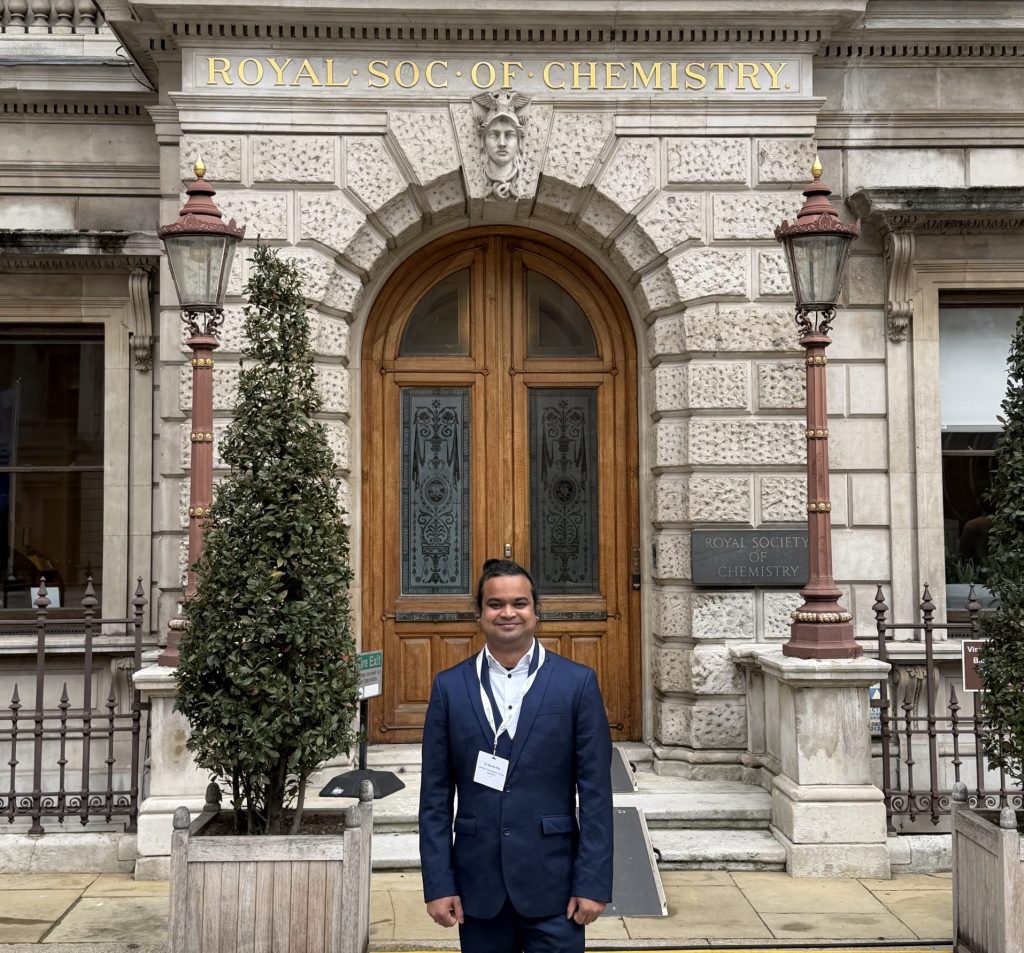
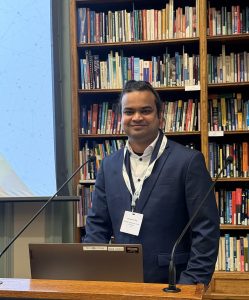
Dr Apurba Ray, Research Scientist at German Aerospace Center (DLR) and part of the GRAPHERGIA consortium, showcased the project through a presentation titled “High-voltage gel polymer electrolyte integrated laser-induced graphene flexible micro-supercapacitors for wearable and sustainable aerospace electronics”.
The talk was part of Session 5: Innovations in battery technologies for space applications, chaired by Dr. Matsushima, on 4 November 2026.
Apurba presented a novel flexible micro-supercapacitor (FMSC) that combines a high-voltage gel polymer electrolyte with laser-induced graphene (LIG) interdigitated electrodes. The device is designed for the demanding conditions found at the boundary between terrestrial and space environments. Its integrated gel polymer structure suppresses evaporation under vacuum and prevents phase separation under extreme vibration or high-g loading, highlighting its potential for unpressurised aerospace environments.
The work builds on two of GRAPHERGIA’s key technologies: laser-assisted graphene production and flexible micro-supercapacitors for energy storage. Thin, flexible, and lightweight, these devices are relevant to both wearable electronics, such as our self-charging e-textiles, and aerospace electronics, where every gram and every cubic centimetre counts.
A different kind of conference
Faraday Discussions are a long-standing series of RSC meetings that put discussion, rather than presentations alone, at their centre. Session 5 brought together nearly 50 participants, including senior professors, scientists, PhD and master’s students and industry partners from the USA, the UK, Germany, Japan, Australia, Belgium and India. Throughout the three-day event, face-to-face scientific exchange was constant and constructive.
For Apurba, the experience was a highlight of his research career:
I feel incredibly proud and honoured to have presented our GRAPHERGIA research at the Faraday Discussions organised by the Royal Society of Chemistry at the historic Burlington House in London, followed by wonderful, in-depth scientific discussions. It was an excellent and engaging event that stood apart from typical conferences, and truly a milestone I will cherish for a lifetime. Special thanks to the RSC for organising such an exceptional event – Dr Apurba Ray, German Aerospace Center (DLR)
Events like this one help GRAPHERGIA connect its research with the international electrochemistry and space communities, and open conversations with researchers and industry interested in lightweight energy storage for demanding applications.
Want to know more?
Flexible micro-supercapacitors were also the focus of our sixth webinar, High-Performance Flexible Micro-Supercapacitors & Advanced Self-Healing Battery Technologies, available on the GRAPHERGIA Hub.
You can also access to the scientific publication ”High-voltage gel polymer electrolyte integrated laser-induced graphene flexible micro-supercapacitors for wearable and sustainable aerospace electronics” now published in our Zenodo Community.
More about the Faraday Discussions
Faraday Discussions are a series of international scientific meetings organised by the Royal Society of Chemistry (RSC) and held since 1907. Each meeting focuses on a rapidly developing area of the chemical sciences and brings together leading researchers, early-career scientists and industry from around the world.
What makes them different from a typical conference is their format: research papers are submitted and shared with participants before the meeting, so speakers give only a brief summary of their work and most of the time is dedicated to open discussion. These discussions are recorded and published, together with the papers, in the journal Faraday Discussions, creating a lasting record of the debate.
Explore more about the Faraday Discussions Journal here.