

Evangelia Tsakali is a Master’s Student in Chemistry conducting her research within GRAPHERGIA at the Institute of Chemical Engineering Sciences-HELLAS (FORTH/ICE-HT), the project coordinator. She focuses on the development of next-generation, binder-free anodes for Li-ion batteries utilising advanced laser-assisted synthesis techniques.
By leveraging laser sources to transform materials into high-quality, conductive graphene layers, her work aims to deliver high-performance and environmentally sustainable electrodes for advanced energy storage applications.
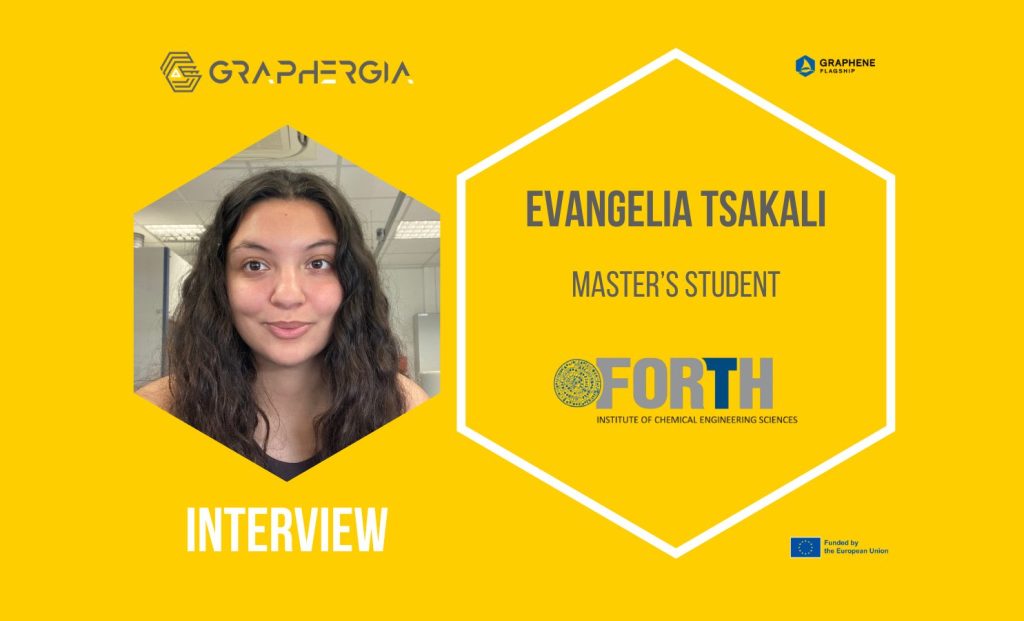
“Beyond learning advanced synthesis methods and battery testing, I have deeply expanded my skills in utilising sophisticated characterisation techniques, such as Raman spectroscopy, to evaluate the quality of our conductive graphene layers.” – Evangelia Tsakali, Master’s Student at FORTH.
Can you briefly describe your research and how it fits into the overall GRAPHERGIA project? What specific problem are you trying to solve with your work on graphene?
My research focuses on the laser-assisted synthesis and transformation of advanced materials to develop binder-free anodes for Li-ion batteries. Within GRAPHERGIA, our specific goal is to use laser sources to synthesise high-quality graphene as a highly conductive material directly onto the electrodes. By solving the problem of low electrical conductivity and eliminating the need for conventional polymer binders, we directly contribute to the project’s core pillar for next-generation energy storage.
What are the main challenges you face in working with graphene at a practical level?
The main challenge is the precise tuning of the laser parameters, such as power and scanning speed, to optimise the quality of the synthesised graphene-like structure. Achieving the ideal network structure to ensure excellent conductivity and structural stability without any binder requires meticulous experimental planning and continuous testing.
How do you collaborate with other teams within the GRAPHERGIA project?
Collaboration is key since the tasks in GRAPHERGIA are highly interconnected. We work closely with teams responsible for battery assembly and electrochemical testing. Through our monthly meetings, we exchange material samples, cross-check performance results, and share technical insights to keep the project running smoothly.
How has being part of GRAPHERGIA shaped your academic or career path so far?
Being part of GRAPHERGIA has significantly advanced my scientific thinking. Beyond learning advanced synthesis methods and battery testing, I have deeply expanded my skills in utilising sophisticated characterisation techniques, such as Raman spectroscopy, to evaluate the quality of our conductive graphene layers. Collaborating with experts and presenting our work has greatly shaped my profile as a young researcher.
How does your research contribute to sustainable energy solutions? What impact could it have on reducing carbon emissions or improving energy efficiency?
Our laser-assisted synthesis approach is environmentally sustainable by design. By using lasers to create the conductive graphene networks, we eliminate the harmful chemical solvents and energy-intensive heating steps used in traditional manufacturing. This reduces carbon emissions during production, while the binder-free design directly improves the battery’s overall energy efficiency.
As GRAPHERGIA is entering its third year of research, are there any early results or breakthroughs you’ve been excited about?
I am particularly excited about our successful fabrication of binder-free anodes featuring these highly conductive, laser-processed graphene networks. Seeing the material transform correctly under the laser and deliver promising battery performance during electrochemical cycling has been a highly rewarding milestone.
How do you see graphene, or more broadly 2D materials, transforming the future of energy in Europe in the next 10–20 years?
Advanced 2D materials like graphene will revolutionise Europe’s energy sector by enabling safer, faster-charging, and more eco-friendly storage systems. Utilising graphene as a key conductive material in laser-assisted, binder-free technologies will be critical for achieving high-performance and commercially viable green energy solutions.
Follow us on LinkedIn, X , BlueSky and YouTube to discover more about GRAPHERGIA and read more interviews like Evangelia’s!