

From graphene materials and energy-harvesting devices to flexible electronics and advanced batteries, GRAPHERGIA has spent the past three years developing the building blocks for a new generation of sustainable energy technologies. Now, those building blocks are coming together as this partnership enters its fourth and final project year.
During Year 3, from October 2025 to September 2026, the project took another important step toward its ultimate goal: demonstrating how graphene and graphene-related materials can be integrated into innovative energy-harvesting and storage solutions for real-world applications. Smart textiles, self-powered aerospace sensing and graphene-based batteries for space are at the heart of this work, bringing together technologies developed by eleven partners across Europe.
This has been a year of integration, testing and refinement. As the three demonstration cases entered their piloting phase in March 2026, GRAPHERGIA moved closer to showing how its research can work beyond individual laboratory components, as complete systems designed around the needs of future applications.
Keep reading to discover how our partners advanced electrode scale-up, battery-module development, and energy-harvesting circuits, while progressing the self-powered smart garment from concept toward a functional textile demonstrator, and what remains to be completed in GRAPHERGIA’s final year.
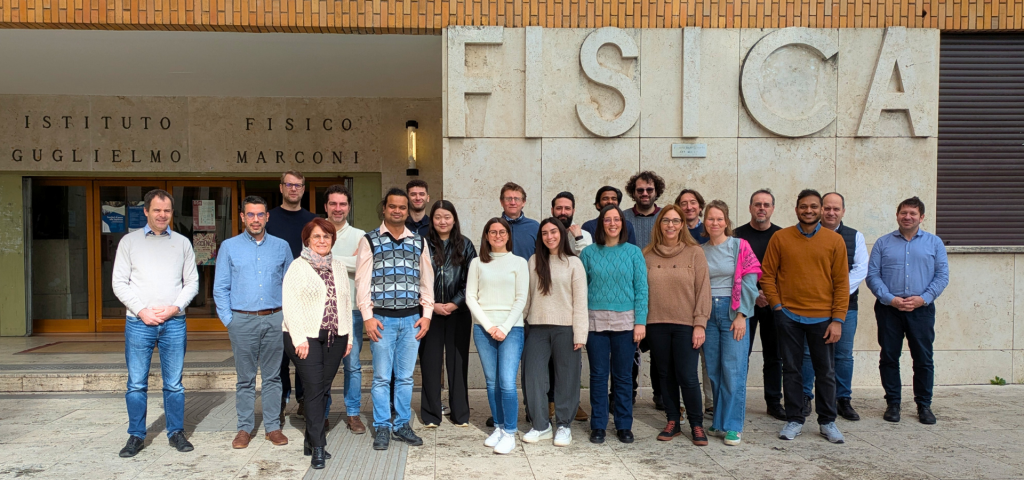
The GRAPHERGIA partners in a Consortium Meeting hosted by Sapienza Università di Roma, February 2026
“This year, our biggest step forward was turning innovative materials into practical energy solutions. We advanced laser-produced anodes for lithium-ion batteries and developed flexible conductive textiles, successfully demonstrating their potential in both energy-harvesting and energy-storage applications.” Spyros Yannopoulos, GRAPHERGIA Project Coordinator (Professor at the Department of Chemistry, University of Patras and collaborating Researcher at FORTH)
Much of this progress rests on the materials developed by Foundation For Research and Technology – Hellas (FORTH), the project coordinator. Over the past year, the FORTH team evaluated a wide range of laser-produced materials as anodes for lithium-ion batteries and established an effective laser-driven approach to anode preparation.
Through an optimized fabrication process, the team developed flexible, electrically conductive graphene-on-textile electrodes that were successfully implemented in flexible energy-harvesting and energy-storage devices. Because these technologies are still under development, establishing consistent and reliable evaluation methods proved more challenging than expected. Close collaboration and continuous exchange of expertise between partners helped the consortium agree on common evaluation metrics and compare results more reliably.
Demo Case 1: An All-in-One Self-Charging Textile
GRAPHERGIA’s first demonstrator aims to prove that a garment can harvest energy from the wearer’s own movement, store it, and power sensing, all within a comfortable, wearable textile. Led by BORN Knitting Engineers, Year 3 has been about turning that concept into a concrete integration strategy.
“This year, our biggest step forward was moving from the general concept of a self-powered garment towards a concrete strategy for harvesting energy from natural human movement and integrating it into textiles. This is important because performance alone is not enough: the technology also needs to work with the body, remain comfortable, and ultimately become part of a usable garment.” Michael Schneider & Facundo Gutierrez, Demo 1 leads, BORN Knitting Engineers
Over the past year, the team explored how energy can be harvested from natural human movement through both compression and sliding, investigating where each mechanism works best on the body and how harvesting, storage, power management and sensing can ultimately come together in one wearable system. The main challenge has been balancing energy harvesting against wearability: sliding offers many opportunities to harvest from body movement but with relatively low forces, while compression provides stronger, more predictable forces, particularly under the foot, but far less available space, especially once other modules are added in. Designing the demonstrator while several of those modules are still under development has made close, continuous coordination across GRAPHERGIA partners essential.
Two other partners’ work feeds directly into this demonstrator. DLR successfully scaled up ionic-liquid-based, high-voltage gel polymer electrolytes (GPEs) this year, integrating them into flexible micro-supercapacitors that were extensively evaluated for charge-discharge performance and long-term cycling stability, over 10,000 cycles, while remaining mechanically flexible up to an operating voltage of 3.2 V, meeting the performance requirements for both Demo 1 and Demo 2.
“A major breakthrough for our research this year was the development of a scalable synthesis route for high-voltage gel polymer electrolytes. Integrated with laser-patterned graphene interdigital electrodes, these micro-supercapacitors demonstrated outstanding capacitance, energy density, long-term cycle life, and mechanical flexibility, directly enabling self-powered e-textiles and structurally integrated aerospace sensing applications.” Apurba Ray, Research Scientist & Bilge Saruhan, Senior Scientist, German Aerospace Center (DLR)
ComSensus’ modular electronics board, designed to harvest energy from graphene-based TENGs in a low-power ‘store-and-fire’ mode, will be tailored to Demo 1 and Demo 2 in the final year (more on that below).
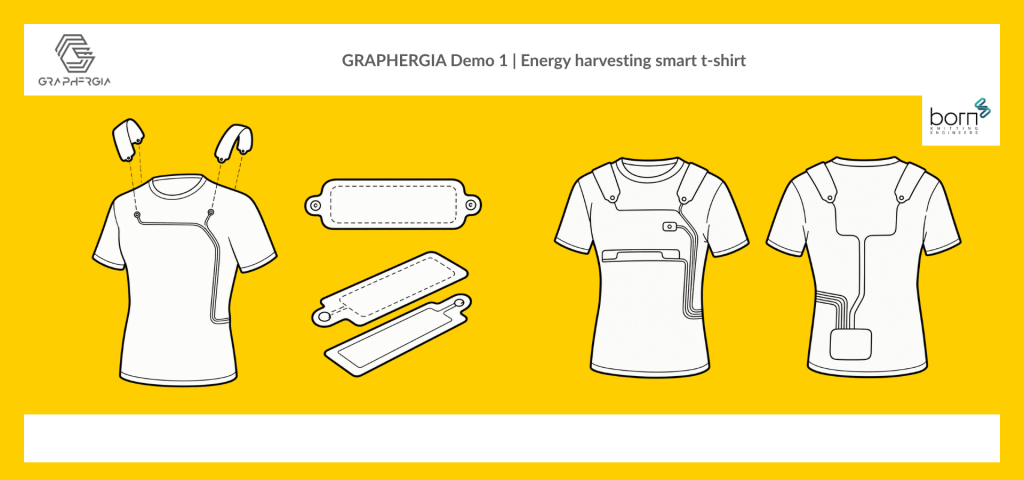
Energy harvesting smart t-shirt from GRAPHERGIA Demo 1 © BORN Knitting Engineers
Demo Case 2: A Self-Powered Sensor for Aerospace Structures
GRAPHERGIA’s second demonstrator, led by Adamant Composites, is a triboelectric nanogenerator (TENG) embedded in a composite aerospace structure, designed to generate usable electrical power simply from the bending and vibration the structure experiences in normal operation.
“This year, our biggest step forward in TENG development was moving from optimizing individual components towards integrating them into a complete demonstrator. Combining the consortium’s expertise in materials, device design and power management has accelerated our progress towards a robust, application-oriented TENG system.” Spyros Tsiotos, Materials and Processes Engineer, Adamant Composites
Using the results and data acquired from lab-scale research, the team has been able to project a clear path towards the demonstrator. The main hurdle has been upscaling optimised lab-scale processes to a semi-industrial level. Work that initial Tasks had nearly perfected at lab scale proved harder to translate at larger scale than expected. The solution came from the consortium’s cross-partner problem-solving, with partners offering support beyond their formal roles.
Université Gustave Eiffel / ESYCOM Lab has been central to making that power usable. Building on two years of theoretical and simulation work, the team experimentally validated the optimisation approach for the TENG and its conditioning circuit this year, identifying the most efficient configuration for energy harvesting. This enabled a complete power-management system that can store harvested energy in either a supercapacitor or a battery.
“This year, our biggest step forward was experimentally validating the TENG and its conditioning circuit combined optimisation. It allowed us to confirm our theoretical and simulation results, i.e. to identify the most suitable conditioning approach and move toward a complete energy-harvesting system capable of managing and storing the converted energy from the mechanical domain in a supercapacitor or a battery.” Philippe Basset, Professor at ESIEE Paris and Director of ESYCOM Lab, Université Gustave Eiffel
On the electronics side, ComSensus, a Slovenian SME specialising in remote monitoring and IoT solutions, has designed and built two versions of a modular electronics board that lets the team test different ways of harvesting energy from graphene-based TENGs, storing it, waking up, and publishing a wireless Bluetooth Low Energy message using only the harvested energy itself. Because each TENG sample behaves differently, the team opted for a modular design where individual circuit blocks can be swapped or reconfigured, and built a custom mechanical tapping device to characterise each sample and tune the electronics to its optimal operating point. A key challenge (TENGs produce relatively high voltage but very low current) was addressed by choosing low-leakage storage capacitors and redesigning the power-management circuit, reducing standby consumption to less than one-fifth of that of the first version.
“This year, our biggest step forward in our research was developing custom and very efficient low-power electronics that work in a store-and-fire mode: energy from the TENG is collected until there is enough, and only then does the device wake up and send a Bluetooth Low Energy message.”Andrej Čampa, R&I Manager, ComSensus


Researchers from FORTH and ComS working on the TENG system design © ComSensus
Demo Case 3: Towards a Graphene-Based LIB Module for Space
Led by Pleione Energy, GRAPHERGIA’s third demonstrator aims to deliver a graphene-based lithium-ion battery (LIB) module built for the demanding power requirements of new space applications, with a CubeSat-compatible design as the target use case.
Over the past year, we successfully scaled up electrodes using the LEST laser-processing method, assembled them into cells, and tested them to evaluate performance. In parallel, the Demo 3 system design was completed, and the team designed, assembled, and is currently testing the first demonstrator built using commercial cylindrical battery cells.
“This year, our biggest step forward was successfully scaling up and testing electrodes developed within GRAPHERGIA, while also progressing from individual cells toward a functional battery demonstrator. This is important because it brings the technologies developed at laboratory scale closer to real-world application and provides the foundation for the final CubeSat battery module.”Athanasios Masouras, COO and Demo 3 lead, Pleione Energy
Scaling a laboratory process up inevitably surfaces challenges invisible at bench scale. The LEST method had to be adapted to reproduce FORTH’s original process at larger scale, and issues with the current collector had to be resolved. It was encouraging to see the cells operate successfully with a dry-processing approach, and that suitable electrolyte additives could improve electrode stability. On the system side, integrating and validating the Battery Management System (BMS) proved more demanding than expected, so the team built and tested the first demonstrator with commercial cylindrical cells to validate the system architecture and BMS operation before moving on to cells developed within GRAPHERGIA.
A complementary line of work comes from Sapienza Università di Roma, where the team upgraded its experimental setup to improve sensitivity to weaker signals and used it to identify wear and ageing in batteries by analysing the electrolyte. They also successfully tested a new reflection-based measurement technique, bringing them a step closer to applying it directly to real (non-transparent) battery components.
“This year, our biggest step forward in our research was the detection of degradation signatures in the battery electrolyte using our newly developed Stimulated Raman Scattering setup, because it demonstrated that we can identify specific chemical fingerprints of ageing, such as manganese oxide dissolution and changes in hydroxide ion behaviour, directly in the battery fluid, opening a new window into understanding battery failure.” Tullio Scopigno, Full Professor, Department of Physics, Sapienza Università di Roma
Applying this reflection-based technique directly to real lithium-ion battery electrodes proved particularly challenging: the electrodes’ naturally rough surfaces scatter light in many directions rather than reflecting it cleanly, making it difficult to extract a clean signal. The team tackled this on two fronts, redirecting the setup to analyse the liquid electrolyte, where measurements are cleaner and the key ageing chemistry happens directly, while continuing to optimise the reflection geometry to improve signal quality from the electrode surfaces themselves.
Stimulated Raman Scattering experimental setup © URM
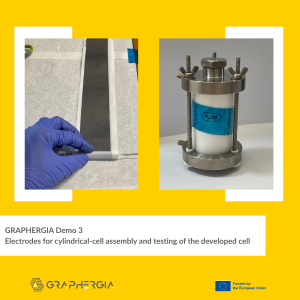
Electrodes for cylindrical-cell assembly and testing of the developed cell © Pleione
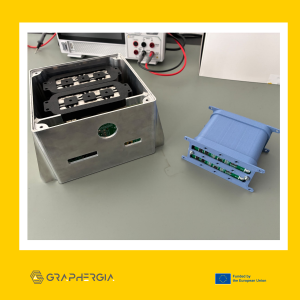
Battery module mock-up © Pleione
Sustainability: From Methodology to Demonstrator-Specific EcoDesign
Sustainability has been part of GRAPHERGIA since Year 1, and in Year 3 that groundwork began yielding concrete results. Led by Next Technology Tecnotessile, the team moved from defining how sustainability should be assessed to applying that approach directly to the three demonstrators, developing preliminary environmental, economic and social assessments and beginning to translate the results into practical EcoDesign recommendations for each technology.
“This year, our biggest step forward in sustainability assessment was moving from a methodological framework to demonstrator-specific results, because this allowed us to start turning environmental, economic and social evidence into practical EcoDesign guidance. Seeing sustainability considerations progressively become part of the actual technology-development process is, for us, one of the most valuable achievements of GRAPHERGIA’s third year.” Matteo Maccanti, Environmental Researcher and LCA Analyst, Next Technology Tecnotessile
Assessing evolving technologies is inherently difficult; materials, processes, and even final demonstrator configurations can change as development progresses. The team addressed this through continuous exchanges with the technical partners, progressively refining data collection, assumptions, functional units and benchmarks as more representative information became available.
Growing the GRAPHERGIA Community
Beyond the lab, AUSTRALO has continued to foster GRAPHERGIA’s impact activities across the project’s communication channels, most notably by releasing the “Human Side of Graphene” podcast series, where researchers and innovators in advanced materials share how they are developing energy-harvesting solutions.
“This year, the biggest step in managing GRAPHERGIA’s impact was the coordination of joint communication, dissemination, and exploitation efforts among the 11 project partners based in six countries, as they all contributed to fostering our visibility and sustaining results at the local, national, European, and even international levels. This year, GRAPHERGIA worked with fellow researchers in Europe, and beyond, from South Korea and Japan.” Mona Marill, Project Manager, AUSTRALO Marketing Lab
Keeping the exploitation strategy alive beyond the project’s own lifetime remains a challenge: partners need a clear picture of their key innovation results, the problems they solve, target markets, and primary end users. GRAPHERGIA continuously updates its exploitation strategy using tools such as the Business Model Canvas to keep that translation on track.
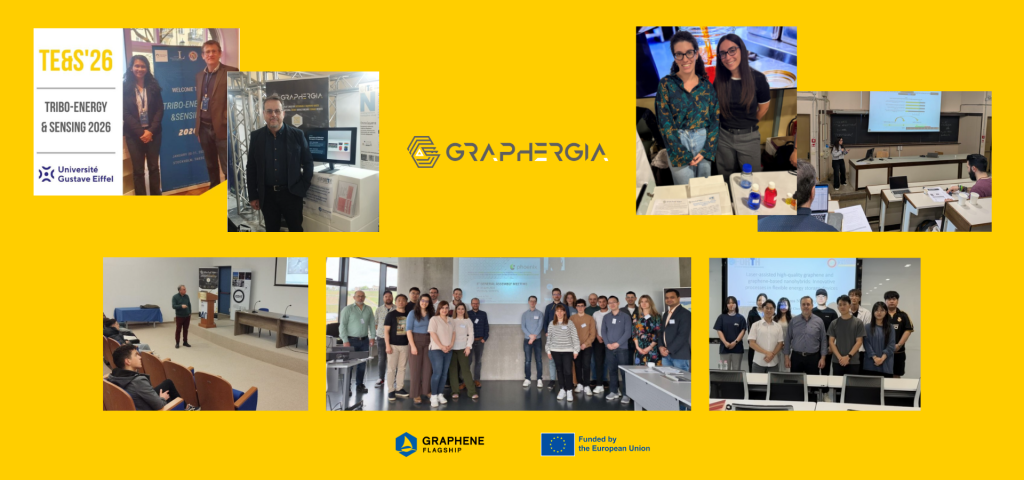
The GRAPHERGIA partners participating in different activities during 2026
Looking ahead to the final year of GRAPHERGIA’s research
As GRAPHERGIA enters its final phase, the consortium’s focus sharpens further on proof: finishing what Year 3 started; delivering working demonstrators and assessing their impact in real-world environments from both technical and sustainable perspectives.
For the self-charging textile, the aim is to move from the current integration and placement strategy to a functional textile demonstrator, completing characterisation of the selected harvesting configurations, integrating the harvesting, storage, power-management and sensing modules, and testing the full system under representative conditions. For the aerospace sensor, the goal is to validate a triboelectric nanogenerator embedded in a composite structure that generates usable electrical power from ‘representative structural loads such as bending and vibration such as bending and vibration. These two demos apply TENG power-management methodology so textile/sensor TENGs can efficiently charge a supercapacitor, and tailor ComSensus’ electronics and signal-processing methods. This approach aims to achieve the best-performing harvesting configuration for each TENG and use case. In parallel, these demonstrators will integrate DLR’s best-performing gel polymer electrolyte formulations DLR’s best-performing gel polymer electrolyte formulations and key performance parameters, followed by comprehensive electrochemical testing.
For the lithium-ion battery module for space applications, the next steps focus on scaling up and manufacturing cells incorporating the project’s developed anodes, and on completing and validating the Demo 3 battery module for the CubeSat application by progressing from the current commercial-cell demonstrator to one built with GRAPHERGIA-developed cells. Furthermore, research on understanding battery ageing will continue by conducting post-mortem studies on battery components and integrating spectroelectrochemical cells into Sapienza’s set-up for real-time monitoring of ageing and degradation under practical operating conditions.
All three demonstrators will complete environmental, economic, and social assessments, compare them with conventional alternatives, and deliver demonstrator-specific EcoDesign recommendations that flag the main hotspots, trade-offs, and improvement opportunities for future uptake.
“Our main objective for the final year is to further optimise the materials’ performance in line with the specific requirements of the final demonstrators. The focus will be on fine-tuning material properties and processing conditions to ensure their effective integration and performance in the targeted applications.” Spyros Yannopoulos, GRAPHERGIA Project Coordinator and Research Director at FORTH
For more updates, follow the GRAPHERGIA journey on LinkedIn, X, and BlueSky, and subscribe to our newsletter to discover how we will keep powering future energy with graphene.
If you want to learn more about the GRAPHERGIA research activities during 2025 and 2026, read the Graphene Flagship Annual Report.