

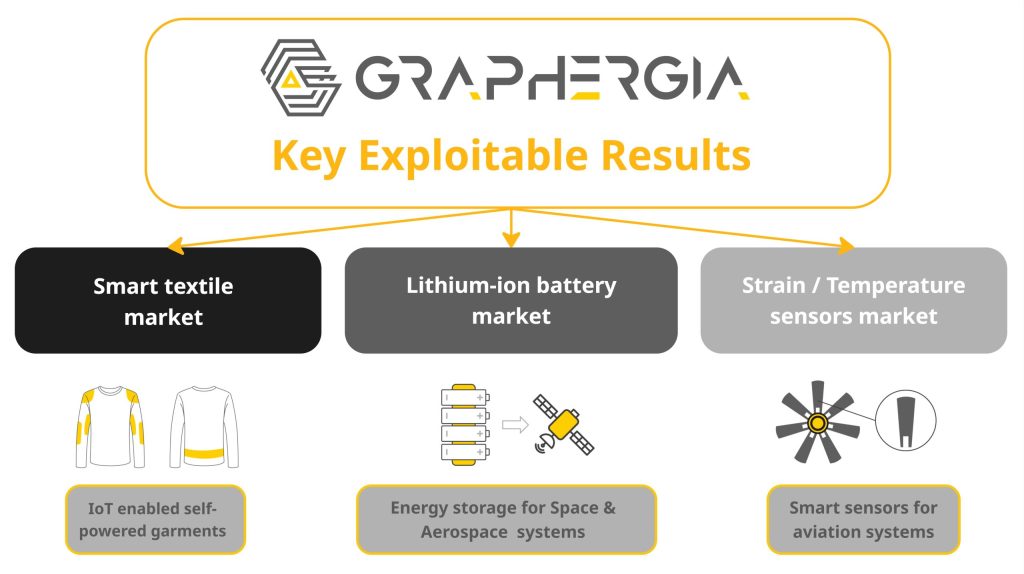
In the realm of advanced materials science, nanomaterial-enabled innovations are transforming energy solutions, such as the GRAPHERGIA project, which is developing novel energy harvesting and storage solutions that are more compact, power-efficient, and adopt a more sustainable approach. In the framework of GRAPHERGIA’s key exploitable results and these three demo cases, the project has assembled a landscape of its target markets, where outstanding gaps and challenges create opportunities for novel solutions.
GRAPHERGIA seeks to transform energy solutions through sustainable, efficient power technologies. It focuses on developing eco-friendly “dry electrode” fabrication for energy storage devices, leveraging the potential of lasers in graphene synthesis. The project also focuses on the development of a novel process for laser-assisted synthesis, functionalisation, and integration of graphene materials into electrodes, with applications piloted in three key areas: energy-autonomous smart textiles, Li-ion batteries for space applications and strain/temperature sensors for aviation systems. These three segments are GRAPHERGIA’s primary target markets for its innovation.
Let’s take a look at the specific challenges and opportunities that these target markets represent for GRAPHERGIA’s innovation!
Self-Powered Smart Textiles for Performance Monitoring
Electronic textiles, or e-textiles, are textiles that incorporate electronic components, enabling functionalities such as sensing, heating, lighting, and data transmission. In this sense, smart clothing, also known as high-tech clothing, smart wear, electronic textiles, or smart fabrics, is designed to monitor the wearer’s health by providing biometric information such as heart rate, body temperature, muscle tension, and pulse rate. GRAPHERGIA aspires to achieve one-step, laser-assisted synthesis, processing, functionalisation and integration of graphene-based materials into energy storage devices, aiming at smart textiles. Self-charging textiles with integrated electronic systems (triboelectric nanogenerators, TENGs) will be used for biomechanical energy harvesting. The project aims to make the charge-as-you-go lifestyle a reality for everyone, steering towards battery-free charging and enhanced IoT connectivity.
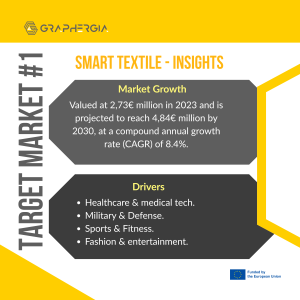
The global e-textile market was valued at €2,73 million in 2023 and is projected to reach €4,84 million by 2030, at a compound annual growth rate (CAGR) of 8.4% during the forecast period. It is experiencing steady growth, driven by technological advancements, the expanding use of e-textiles across industries, and growing interest in intelligent and wearable devices.
The globally growing e-textile market offers several significant opportunities related to emerging technologies, advances in materials science, increased adoption of sports and health-tracking systems, and growing military and defence sector needs. But it faces several key challenges, notably high production costs associated with high-quality electronic components, and technical challenges related to durability, flexibility, and washability over long periods. Also, regulatory and safety concerns create a market barrier, as e-textiles fall under both textile and electronic regulations, requiring compliance with multiple standards. To be competitive in the market, new smart textiles should respond to these challenges.
GRAPHERGIA’s first demo, ‘All-in-one self-charging textile capable of energy harvesting and storage’, focuses on smart textile applications. Led by BORN Knitting Engineers, it integrates advanced electronic components directly into fabrics, enabling battery-free wearable solutions supporting wellness and performance monitoring. Three use cases are being explored: a smart textile system featuring a T-shirt designed for energy harvesting and storage; a belt for real-time gait monitoring; and a self-powered smart seating prototype that will function as an autonomous passenger seat indicator.
Integrated Strain and Temperature Sensors for Aerospace
GRAPHERGIA designs a sensor that is structurally integrated, meaning it can be embedded directly into aviation structures like wings or fuselages; and self-powered, harvesting its own energy rather than relying on batteries or wiring. This sensor measures strain (e.g., to detect deformation, stress, or potential fatigue in structural components) and temperature (e.g., to monitor thermal conditions that may affect material performance) in aviation structures, enabling real-time monitoring of structural integrity and conditions without external power sources.
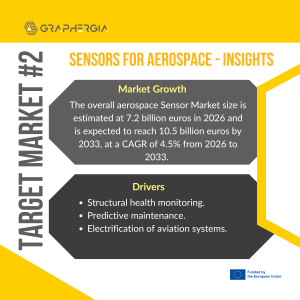
With regard to the related market insights, the overall aerospace sensor market size is estimated at 7.2 billion euros in 2026 and is expected to reach 10.5 billion euros by 2033, at a CAGR of 4.5% from 2026 to 2033. North America leads this sector with the highest market share at 38%, followed by Europe (30%), and Asia Pacific (25%). In line with this, the global temperature sensor market size was estimated to grow at a CAGR of 6.0% from 2024 to 2030. The market growth is due to rising applications of temperature sensors and growth in the electronics sector, and the Asia Pacific region was the largest market in 2023. Moreover, the market growth is expected to be similar for the Strain Gauge Market. The market size is estimated to evolve at a CAGR of 5.1% from 2026 to 2033.
The increasing use of smart sensors supports the growing trend of Industry 4.0, where automation and data exchange are critical for efficiency and productivity. As airlines adopt structural health monitoring and predictive maintenance for their aircraft, demand for permanent strain and temperature sensor installations and for data analytics increases.
The key challenges are related to harsh-environment qualification. Sensors for aerospace/space applications must meet vibration, shock, radiation, vacuum, thermal cycling, and long-life specifications. Therefore, certification is lengthy and expensive. In addition, integration and wiring complexity can be a challenge where distributed sensors require lightweight cabling or data concentrators, which can add integration and weight penalties. GRAPHERGIA’s sensor solutions tackle these barriers.
The project’s second demonstrator, ‘Self-powered structurally integrated sensor for aerospace structures’, targets this sector, and it is guided by Adamant Composites. It focuses on a self-powered, miniaturised sensor embedded within composite materials powered by a triboelectric nanogenerator. This system will enable wireless monitoring of strain and temperature, providing continuous insight into material performance during operation.
Advanced Li-ion Batteries for Low-Orbit Satellite Missions
Across Europe, following the Battery 2030+ roadmap, the research actions are to radically transform the way we discover, develop, and design ultra-high-performance, durable, safe, sustainable, and affordable batteries for use in real applications. GRAPHERGIA follows the roadmap principles by developing a credible, graphene-enabled dry-electrode approach to fabricate next-generation LIB cells. In this sector, the project aims to develop a piloted process for a scalable, cost-effective, and climate-neutral production line for advanced Li-ion batteries.
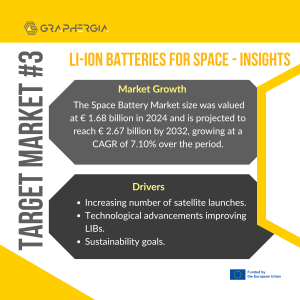
The space battery market, particularly lithium-ion (Li-ion) batteries, is anticipated to grow substantially in the coming years, driven by the increasing number of satellite launches and advancements in space exploration technologies. Space Battery Market size was valued at €1.57 billion in 2023 and is poised to grow from €1.68 billion in 2024 to €2.67 billion by 2032, growing at a CAGR of 7.10% during the forecast period (2025-2032). Overall, the aerospace and space sectors’ increasing reliance on lithium-ion batteries, driven by technological advancements and sustainability goals, is expected to continue market expansion through 2030.
The key challenge on the spatial battery market is ensuring battery reliability and meeting stringent aerospace safety standards. Even more, to withstand the harsh conditions of space, batteries must meet rigorous standards for reliability, durability, and safety. Also, high production costs of Li-ion batteries, covering raw materials and manufacturing processes, combined with scalability issues, may hinder widespread market adoption. These are the key challenges GRAPHERGIA’s researchers are testing with their lithium-ion battery prototype on a low-orbit satellite.
Pleione Energy leads GRAPHERGIA’s third demonstrator, ‘Advanced graphene-based LIB module prototype for space applications’ on this sector. It supports the development of a rigorous qualification protocol for cylindrical LIB cells, ensuring both electrochemical performance and mechanical integrity for integration to CubeSat missions. The module will comprise battery cells, a management system, interconnectors, and supporting structures, and will be prepared for in-orbit validation and future use in space applications.
Towards the Exploitation of GRAPHERGIA’s Key Results
The GRAPHERGIA consortium initiated the pilot phase (at Technological Readiness Level 6) in March 2026 to gather performance data, which will help our researchers and innovators assess the novelty and added value of the GRAPHERGIA solutions to the target markets. In parallel, the partners pursue Intellectual Property Rights (IPR) management by investigating potential patent filing and licensing agreements. Beyond commercial exploitation, partners envisage exploiting results in their future scientific and technological work.
The project’s research will run until 2027 – stay tuned for more results from GRAPHERGIA’s energy solutions!
Find more information and all used sources in our Deliverable 7.2 Plan for D&C&E of the results – Updated version.