

Dimitra Markoglou is a graduate of the Department of Chemistry at the University of Patras, where she is currently pursuing her Master’s Degree. Within the GRAPHERGIA project, she conducts her research at the Institute of Chemical Engineering Sciences-HELLAS (FORTH/ICE-HT), the project coordinator.
Her main role focuses on the development of graphene-based nanostructures using the electrospinning method. By leveraging laser sources to transform materials into high-quality, conductive graphene layers, Dimitra’s work aims to deliver high-performance and environmentally sustainable electrodes for advanced energy storage applications.
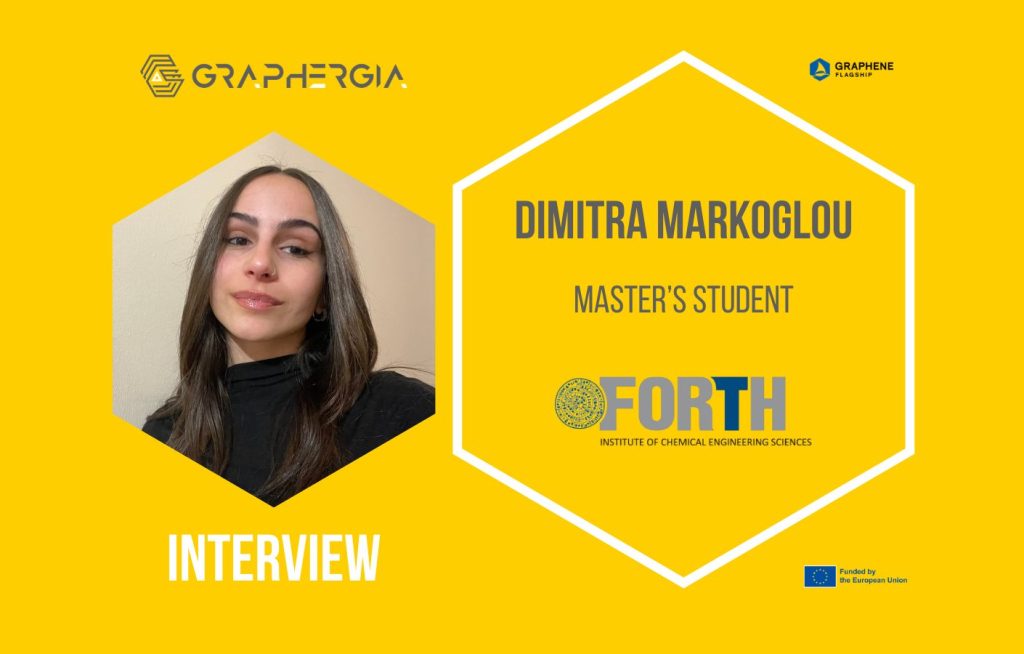
“Working within an interdisciplinary research team has broadened my scientific perspective and shaped my career toward becoming a researcher who bridges nanomaterial synthesis, advanced material processing and device engineering for energy storage and conversion technologies.” – Dimitra Markoglou, Master’s Student at FORTH.
Can you briefly describe your research and how it fits into the overall GRAPHERGIA project? What specific problem are you trying to solve with your work on graphene?
My research is centered on the fabrication of graphene-based electrodes for Supercapacitors (SCs) via electrospinning and evaluation of interdigitated devices via electrospinning, using biobased material as precursor compound, and more specifically, lignin. Electrospinning provides precise control over morphology and enhances porosity and surface area in comparison to bulk materials, which are critical parameters for charge transport and ion diffusion in electrochemical devices.
What are the main challenges you face in working with graphene at a practical level?
While using the electrospinning method, the main challenges include producing continuous and defect-free fibers from lignin-based precursor compounds, as lignin’s complex molecular structure and limited spinnability often make stable fiber formation difficult. Optimizing the electrospinning parameters to achieve uniform fiber morphology and diameter with reproducible properties on an industrial scale is another challenge, as well as controlling fiber shrinkage and pore collapse during post-treatment processes, such as stabilization and laser treatment in order to preserve the material’s high surface area and porous structure.
How do you collaborate with other teams within the GRAPHERGIA project?
I collaborate by supplying electrospun nanofiber electrodes for characterization. Our team members perform Raman, XPS and SEM in order to study the structure and the morphology of the electrospun nanofibers.
How has being part of GRAPHERGIA shaped your academic or career path so far?
Being part of GRAPHERGIA has strengthened my expertise in electrospinning, nanomaterials processing and electrochemical characterization. It has provided me with the opportunity to apply a highly versatile laboratory technique to address challenges relevant to industrial-scale applications. Working within an interdisciplinary research team has broadened my scientific perspective and shaped my career toward becoming a researcher who bridges nanomaterial synthesis, advanced material processing and device engineering for energy storage and conversion technologies.
How does your research contribute to sustainable energy solutions? What impact could it have on reducing carbon emissions or improving energy efficiency?
Electrospun graphene-based free-standing electrodes offer a promising route toward high-performance, lightweight and durable energy storage devices. Their enhanced electrical conductivity, high charge storage capacity, and excellent cycling stability contribute to improved energy efficiency, faster charge-discharge rates and extended device lifetimes. Furthermore, electrospinning is a versatile and cost-effective fabrication technique that can employ low-toxicity solvents and bio-based precursor materials, supporting more sustainable manufacturing practices. Ultimately, these developments support the transition to cleaner energy technologies by improving the efficiency and sustainability of next-generation energy storage systems.
As GRAPHERGIA is in its third year of research, are there any early results or breakthroughs you’ve been excited about?
Yes! One of the most promising outcomes of our work has been the successful fabrication of electrospun carbon nanofibers from Lignin/PAN precursor blends, followed by laser-induced graphitization, which further enhanced their electrical conductivity and electrochemical performance. The resulting electrodes exhibited high specific capacitance, excellent rate capability and outstanding cycling stability. These findings demonstrate that the fabrication of the electrospun fibers based entirely on pure lignin is within reach. Overall, this work highlights the potential of combining electrospinning with laser-induced graphitization to develop high-performance, bio-based electrodes for next-generation energy storage devices.
How do you see graphene, or more broadly 2D materials, transforming the future of energy in Europe in the next 10–20 years?
Advanced 2D materials, particularly graphene, combined with electrospinning and laser-assisted, binder-free fabrication technologies, are expected to play a pivotal role in the next generation of energy storage devices. These approaches enable the scalable production of lightweight, flexible, and high-performance fibrous electrodes with enhanced conductivity, rapid charge-discharge capability and long-term stability. Coupled with the use of sustainable precursors such as lignin, they offer a pathway toward greener and more cost-effective manufacturing. Together, these innovations will accelerate the commercialization of safer and more efficient batteries and supercapacitors, supporting Europe’s transition to a sustainable, climate-neutral energy future.
Follow us on LinkedIn, X , BlueSky and YouTube to discover more about GRAPHERGIA and read more interviews like Dimitra’s!