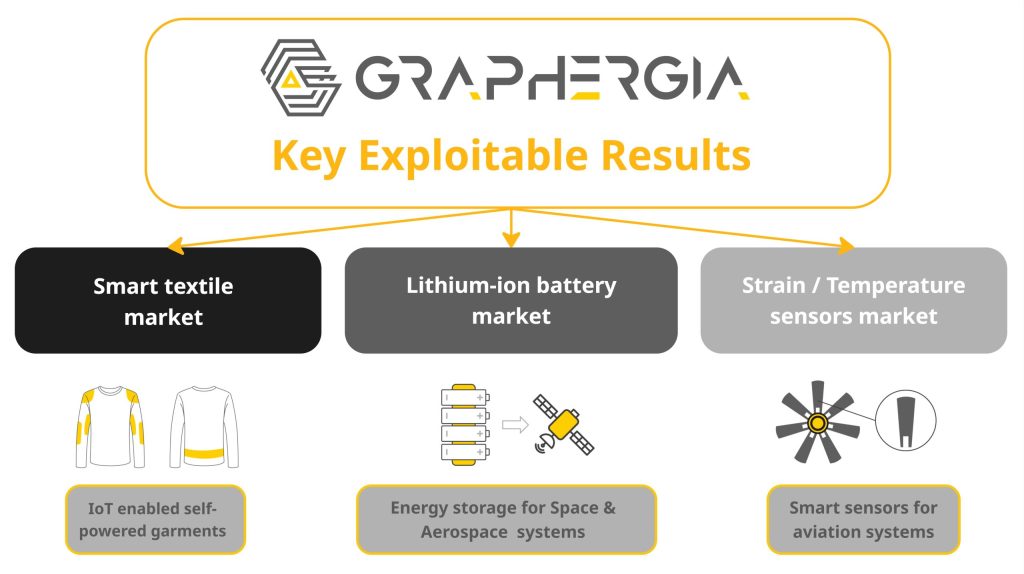
From advanced graphene manufacturing processes to self-powered smart textiles, next-generation sustainable Li-ion batteries and structurally integrated sensors for aerospace applications, GRAPHERGIA is translating graphene-based technologies into innovative solutions for energy harvesting and storage, with clear routes towards exploitation.
The project’s eight Key Exploitable Results (KERs), linked to our three demo cases, capture the outcomes of the work carried out by GRAPHERGIA, demonstrating how graphene can move beyond laboratory-scale materials research to become an enabling technology for scalable, eco-friendly and high-performance products and processes.
We asked the GRAPHERGIA partners leading each KER to explain its innovation in a quote, highlighting the added value it brings compared with solutions already available on the market. Do you want to discover what they told us? Keep reading to explore GRAPHERGIA’s eight Key Exploitable Results and see how they could shape the future of graphene-based technologies!
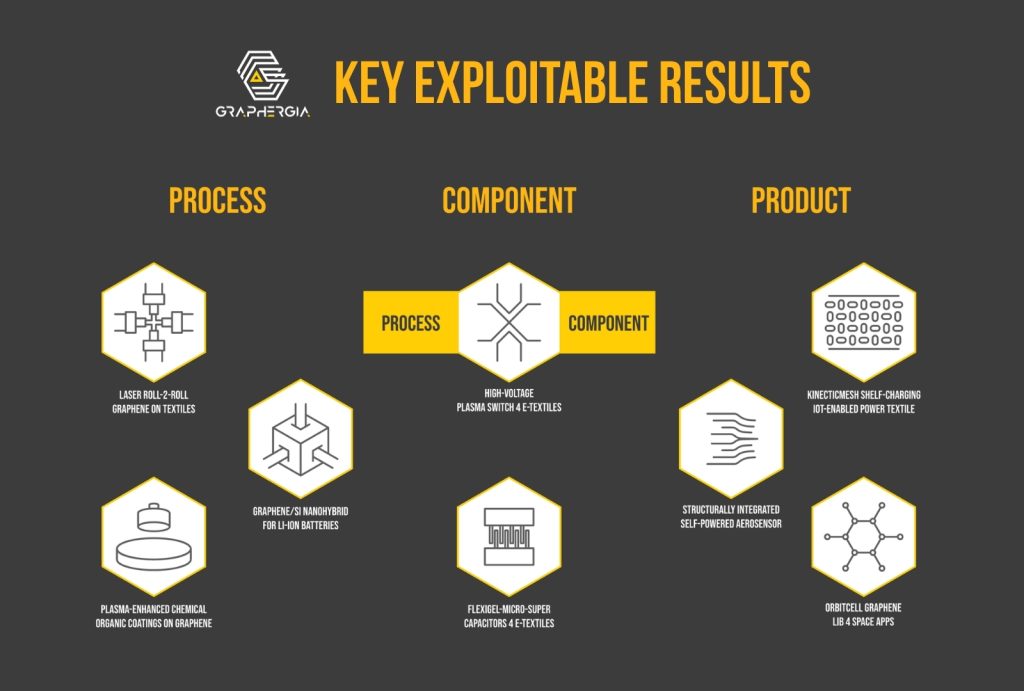
1. Laser Roll-2-Roll Graphene on Textiles
- Type: Process.
- Target markets: E-textiles, smart sensors.
- KER owners: Foundation for Research and Technology Hellas (FORTH) and Adamant Composites.
“Our Laser Roll-2-Roll KER replaces chemical-heavy, batch-based coating with a 100% digital, water-free synthesis. By using precision laser-induced transformation, we deposit high-conductivity graphene directly onto textiles with zero toxic waste or binders. This green, high-speed process ensures superior material quality and structural integrity, offering a scalable, software-defined manufacturing route that aligns graphene’s performance with the EU’s circular digital economy.” – Spyros Yannopoulos, GRAPHERGIA Project Coordinator and Research Director at FORTH.
2. Graphene/Si Nanohybrid for Li-ion Batteries
- Type: Process.
- Target market: Li-ion batteries.
- KER owners: Foundation for Research and Technology Hellas (FORTH), Pleione Energy and Adamant Composites.
“Our Graphene/Si Nanohybrids disrupts Li-ion anode production by replacing solvent-heavy “wet” coating with a purely dry laser-irradiation process. By transforming SiC particles directly into graphene decorated with Si nanoparticles, we eliminate toxic solvents and energy-intensive drying. This one-step digital synthesis delivers a high-conductivity, high-capacity anode with superior structural integrity, drastically reducing the carbon footprint of Giga-factory manufacturing.” – Spyros Yannopoulos, GRAPHERGIA Project Coordinator and Research Director at FORTH.
3. Plasma-Enhanced Chemical Organic Coatings on Graphene
- Type: Process.
- Target markets: E-textiles, smart sensors.
- KER owners: P2i, Foundation for Research and Technology Hellas (FORTH) and Next Technology Tecnotessile.
“The PE-CVD process for organic coatings on graphene-coated textiles combines protection and functionality. It enables the development of textiles capable of energy generation with low environmental impact, while ensuring durability, flexibility and comfort. Unlike conventional textile treatments, PE-CVD deposits ultra-thin functional coatings directly from the gas phase, minimising chemical consumption and enabling precise control of surface properties.” – Elena Merli, Chemical Researcher at Next Technology Tecnotessile.
4. FlexiGel-Micro-Super Capacitors for E-Textiles
- Type: Component.
- Target market: E-textiles.
- KER owners: German Aerospace Center (DLR), Foundation for Research and Technology Hellas (FORTH) and Adamant Composites.
“Our Gel Polymer Electrolytes (GPEs), integrated with high-voltage Ionic Liquids (ILs), serve as a critical bridge between liquid and solid-state systems. They provide a robust solution for micro-flexible Supercapacitors (mfSCs), meeting the rigorous mechanical and environmental demands of smart textiles and aerospace applications. By offering a leakage-free, separator-free architecture with a wide electrochemical window and enhanced safety, these GPEs facilitate seamless ‘on-chip’ integration for wearable electronics. Furthermore, our mfSCs (fabricated on laser-induced, roll-to-roll interdigital graphene electrodes) demonstrate exceptional mechanical conformality, self-healing capabilities, and the breathability required for user comfort.” – Apurba Ray, Research Scientist at German Aerospace Center (DLR).
5. High-Voltage Plasma Switch for E-Textiles
- Type: Process / Component.
- Target market: E-textiles.
- KER owners: Université Gustave Eiffel, Foundation for Research and Technology Hellas (FORTH) and Adamant Composites.
“High-voltage floating switches are a key component in maximising energy conversion in triboelectric kinetic energy harvesters. Replacing silicon with silicon carbide in the fabrication of high-voltage plasma switches will significantly improve the reliability of devices when operating at high voltages of several hundred volts.” – Phlippe Basset, Professor at ESIEE Paris – Université Gustave Eiffel.
6. KineticMesh Shelf-Charging IoT-Enabled Power Textile
- Type: Product.
- Target market: E-textiles.
- KER owners: Born Knitting Engineers, Foundation for Research and Technology Hellas (FORTH) and Adamant Composites.
“Energy harvesting is the decisive enabler for the mass market adoption of smart textiles. Without integrated energy generation and storage, wearable systems remain dependent on external batteries, limiting scalability, usability, and sustainability. All-in-one self-charging power textiles unlock true energy autonomy and open significant market opportunities across healthcare, industrial safety, defense, sports, and IoT. Integrated energy systems will define the next generation of smart textiles and create a new benchmark for performance, reliability, and commercial viability.” – Michael Schneider, CEO at Born Knitting Engineers.
7. Structurally Integrated Self-Powered AeroSensor
- Type: Product.
- Target market: Smart sensors.
- KER owners: Adamant Composites, Foundation for Research and Technology Hellas (FORTH), Université Gustave Eiffel and German Aerospace Center (DLR).
“What I find most exciting about this innovation is the ability to integrate sensing and power generation directly within composite structures. With the Structurally Integrated Self-Powered AeroSensor, we move beyond traditional add-on sensors toward smart materials that can continuously monitor their own condition without external power sources or compromising structural integrity.” – Despoina Batsouli, Head of Advanced Materials Division at Adamant Composites.
8. OrbitCell Graphene LIB for Space Applications
- Type: Product.
- Target market: Li-ion batteries for space applications.
- KER owners: Foundation for Research and Technology Hellas (FORTH), Adamant Composites and Pleione Energy.
“By integrating graphene into advanced battery architectures, we enable energy storage that is not only more powerful, but fundamentally more reliable. Graphene’s exceptional properties enhance charge transport within the cell, supporting higher power delivery while significantly extending cycle life. The result is a new generation of batteries designed to operate consistently and efficiently over thousands of cycles, meeting the growing demand for reliable energy systems in aerospace. The GRAPHERGIA project plays a key role in unlocking these capabilities by enabling cost-effective and sustainable manufacturing processes.” – Athanasios Masouras, COO at Pleione Energy.
Together, the eight key exploitable results show how GRAPHERGIA is working to turn the exceptional properties of graphene into scalable, sustainable and commercially relevant technologies, covering specific target markets from the textile and battery industries to smart sensing and aerospace.