

Hachem Mortada is now in the third year of his PhD at ESIEE Paris, a school of engineering which is a founding member of the Université Gustave Eiffel (UGE), one of the GRAPHERGIA partners. After earning both his Bachelor’s and Master’s Degrees in Fundamental Physics from the Lebanese University, he went on to specialise in Fluid Mechanics at École Centrale de Lyon and Université Claude Bernard in France.
But his research path has taken him through a variety of topics, including a placement at Avignon Université, where he explored the ratchet effect in periodically arranged particles using numerical modelling tools such as OpenFOAM and FreeFem++.
Today, as part of the GRAPHERGIA project, Hachem is delving into the optimisation of conditioning circuits powered by triboelectric nanogenerators (TENGs) with low capacitance variation, work aimed at pushing the boundaries of energy-harvesting efficiency.
Read our interview with Hachem to discover more about his research and how he is involved in GRAPHERGIA!
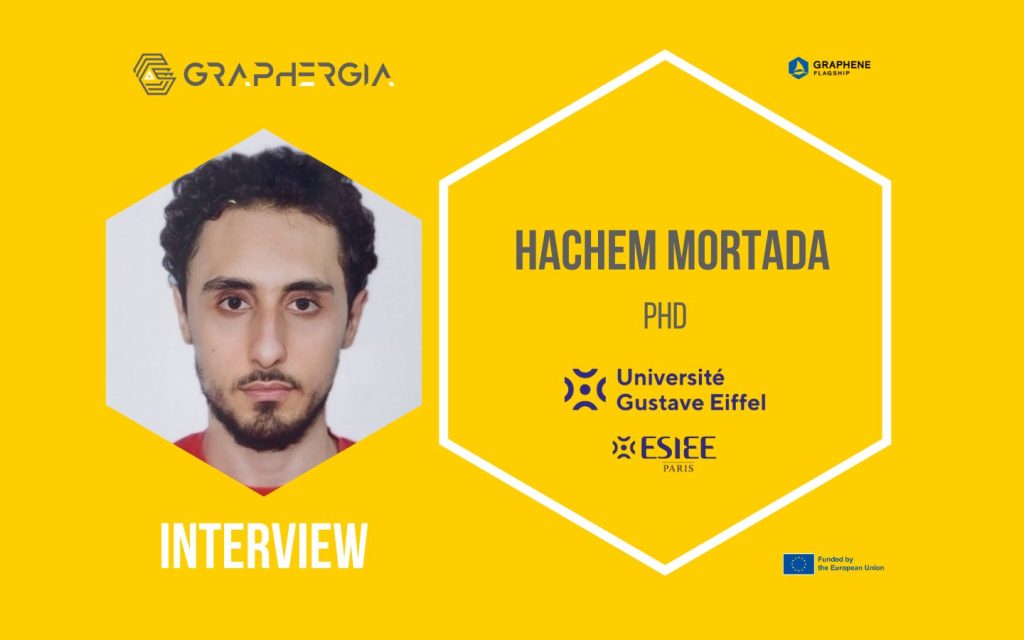
“By optimising energy harvesting circuits for graphene-based TENGs, my research aims to improve the efficiency and adaptability of self-powered systems. This could lead to sustainable and low-cost energy solutions for wearable technologies, sensors, and small-scale electronics” – Hachem Mortada, PhD at ESIEE Paris – University Gustave Eiffel.
Can you briefly describe your research and how it fits into the overall GRAPHERGIA project? What specific problem are you trying to solve with your work on graphene?
My research is centered on graphene-based textiles, which typically exhibit low capacitance variations. The main goal is to develop and adapt specific rectifier circuits capable of efficiently harvesting energy from such systems.
To achieve this, I work on unstable charge pump circuits, exploring their behavior and optimisation for low-capacitance-variation TENGs.
What are the main challenges you face in working with graphene at a practical level?
One of the main challenges is bridging the gap between theoretical modeling and practical simulation. During the first year of my PhD, I developed a mathematical optimisation method to identify circuits that maximize harvested energy based on the TENG’s characteristics, such as triboelectric voltage and capacitance ratio.
Applying this theoretical approach to realistic simulations and experimental conditions is complex, and ensuring the model remains accurate and efficient in practice is a significant challenge.
How do you collaborate with other teams within the GRAPHERGIA project?
We maintain close collaboration through regular online meetings on Microsoft Teams and periodic in-person meetings.
How has being part of GRAPHERGIA shaped your academic or career path so far?
GRAPHERGIA has significantly broadened my perspective as a researcher. It exposed me to interdisciplinary approaches, combining physics, materials science, and electrical engineering, and opened new possibilities for contributing to sustainable energy solutions. It has also strengthened my ability to work within international research networks.
How does your research contribute to sustainable energy solutions? What impact could it have on reducing carbon emissions or improving energy efficiency?
By optimising energy harvesting circuits for graphene-based TENGs, my research aims to improve the efficiency and adaptability of self-powered systems. This could lead to sustainable and low-cost energy solutions for wearable technologies, sensors, and small-scale electronics, ultimately contributing to energy efficiency and reduced reliance on conventional power sources, and indirectly helping lower carbon emissions.
As GRAPHERGIA is entering its third year of research, are there any early results or breakthroughs you’ve been excited about?
We are now approaching the completion of the theoretical and simulation phase. The next step, planned for early next year, is the experimental validation of our models and circuits. This transition from theory to experiment is an exciting milestone, as it will allow us to test our optimisation strategies in real-world conditions.
How do you see graphene, or more broadly 2D materials, transforming the future of energy in Europe in the next 10–20 years?
I believe graphene and other 2D materials will play a crucial role in the development of next-generation energy technologies. Their unique electrical, mechanical, and thermal properties can lead to high-efficiency energy storage, flexible electronics, and wearable energy harvesters.
In the next 10–20 years, these materials could enable decentralised and sustainable energy systems, contributing significantly to Europe’s green transition and carbon neutrality goals.
Follow us on LinkedIn, X , BlueSky and YouTube to discover more about GRAPHERGIA and read more interviews like Hachem’s!