

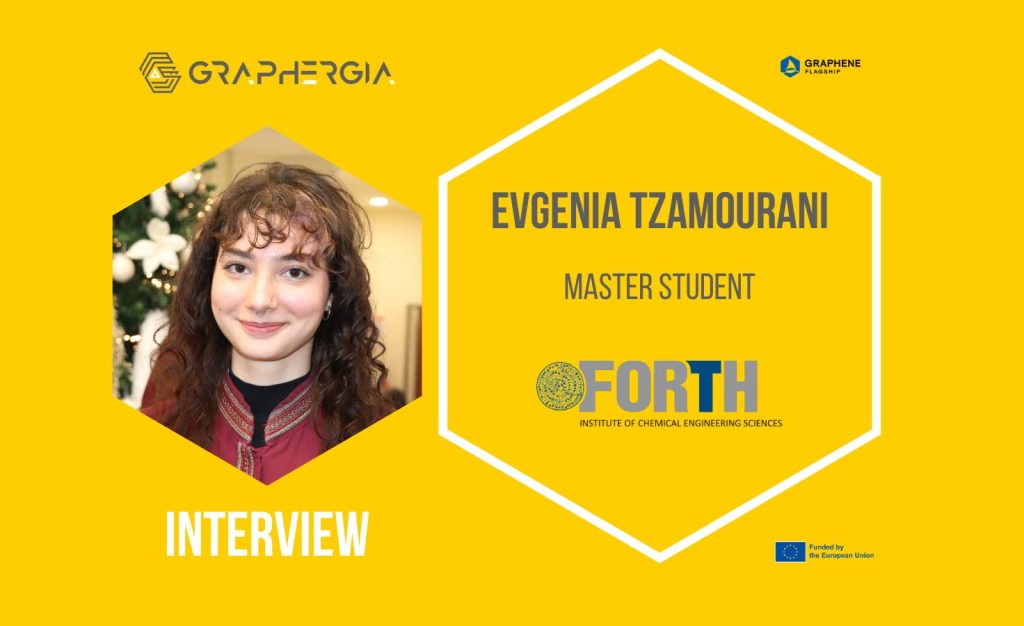
Evgenia Tzamourani holds a Bachelor’s Degree in Physics and she is currently a Master Student. Within GRAPHERGIA, her main role at Institute of Chemical Engineering Sciences (FORTH/ICE-HT), our project coordinator, focuses on the development of graphene-based nanostructures using the electrospinning method. This technique allows Evgenia to fabricate fibrous, porous, and conductive membranes that serve as advanced electrodes for energy storage applications.
Read her interview to discover more about her research and her vision on how 2D materials will transform our energy landscape!
“One exciting result has been the successful laser induced graphitization of electrospun polymeric PAN precursors integration of graphene into electrospun carbon nanofibers, which demonstrated enhanced electrical conductivity and improved specific capacitance compared to pristine fibers. Additionally, we observed that heteroatom doping during the electrospinning/laser irradiation process significantly boosts electrochemical activity by introducing pseudocapacitive behavior.” – Evgenia Tzamourani, Master Student at FORTH.
Can you briefly describe your research and how it fits into the overall GRAPHERGIA project? What specific problem are you trying to solve with your work on graphene?
My research is centered on the fabrication of graphene-based electrodes for SuperCapacitors (SCs) via electrospinning and on the development and evaluation of interdigitated devices via electrospinning. Electrospinning provides precise control over morphology, and enhances porosity and surface area in comparison to bulk materials, which are critical parameters for charge transport and ion diffusion in electrochemical devices. Within GRAPHERGIA, my work contributes to the WP2: Design, development and optimization of textile-based TENGs and micro-flexible SCs. More specifically over the past months my attribution was mainly in Task 2.4: Fabrication and integration of micro-flexible SCs on textiles.
What are the main challenges you face in working with graphene at a practical level?
While using the electrospinning method, the main challenges include:
- Scalability: While electrospinning is versatile, producing uniform fibers at industrial scale with reproducible properties requires optimization of process parameters (voltage, flow rate, solvent systems).
- Structural integrity: Controlling shrinkage or pore collapse during post-treatment (e.g., stabilization, carbonization, laser treatment) is critical to preserve high surface area.
- Performance: During the electrospinning process, fibers tend to dry before they reach the collector (while using Ferric oxide as additive) yielding undesirable morphologies, which cannot be utilized.
How do you collaborate with other teams within the GRAPHERGIA project?
I collaborate by supplying electrospun nanofiber electrodes for characterization. For instance, other teams perform Raman, XPS, and SEM to study the structure and the morphology of the electrospun nanofibers.
How has being part of GRAPHERGIA shaped your academic or career path so far?
Being part of GRAPHERGIA has strengthened my expertise in electrospinning, nanomaterials processing, and electrochemical characterization. It has also given me the opportunity to apply a highly tunable laboratory technique to address industrial-scale challenges. Collaborating with interdisciplinary teams has shaped my career path toward becoming a researcher who bridges nanomaterial synthesis with applied device engineering in the energy sector.
How does your research contribute to sustainable energy solutions? What impact could it have on reducing carbon emissions or improving energy efficiency?
Electrospun graphene-based free-standing electrodes contribute to high-performance, durable, and lightweight energy storage devices. By optimizing charge storage capacity, conductivity, and cycling stability, these electrodes enable longer lifetimes and faster charge–discharge rates. Moreover, electrospinning, a cost-effective technique, in many cases allows the use of low toxicity or green solvents and bio-based polymers, aligning the synthesis process with sustainability principles. The overall impact is to reduce reliance on critical raw materials and contribute to lower carbon emissions through improved renewable energy storage systems.
As GRAPHERGIA is entering its third year of research, are there any early results or breakthroughs you’ve been excited about?
Yes. One exciting result has been the successful laser induced graphitization of electrospun polymeric PAN precursors integration of graphene into electrospun carbon nanofibers, which demonstrated enhanced electrical conductivity and improved specific capacitance compared to pristine fibers. Additionally, we observed that heteroatom doping during the electrospinning/laser irradiation process significantly boosts electrochemical activity by introducing pseudocapacitive behavior. These findings highlight electrospinning as a powerful method for tailoring hierarchical electrode structures.
How do you see graphene, or more broadly 2D materials, transforming the future of energy in Europe in the next 10–20 years?
In the coming decades, electrospinning combined with 2D materials such as graphene will enable the scalable fabrication of advanced fibrous electrodes for high-energy-density batteries and hybrid supercapacitors. The tunability of this approach allows for lightweight, flexible, and high-performance devices, supporting applications in electric vehicles, grid-scale storage, and wearable electronics. More broadly, 2D materials will also advance catalytic systems for hydrogen production and CO₂ conversion, positioning Europe at the forefront of the energy transition and contributing to climate-neutral targets.
Follow us on LinkedIn, X , BlueSky and YouTube to discover more about GRAPHERGIA and read more interviews like Evgenia’s!