

The 11 partners forming the GRAPHERGIA consortium gathered during two days, on the 19th and 20th of February 2026, for the fourth General Assembly, hosted in Sapienza Università di Roma (Rome, Italy), and organised by our partner Tullio Scopigno, Full Professor in the Physics Department. The main objective of this meeting was to advance the deployment and methodologies for our three demonstration cases, with a consistent focus on eco-design principles:
- All-in-one self-charging textile capable of energy harvesting and storage.
- Self-powered structurally integrated sensor for aerospace structures.
- Advanced graphene-based LIB module prototype for space applications.
This is the last of our four general assemblies, previously celebrated in Patras (Greece), where we kicked off GRAPHERGIA, Prato (Italy), and Paris (France).
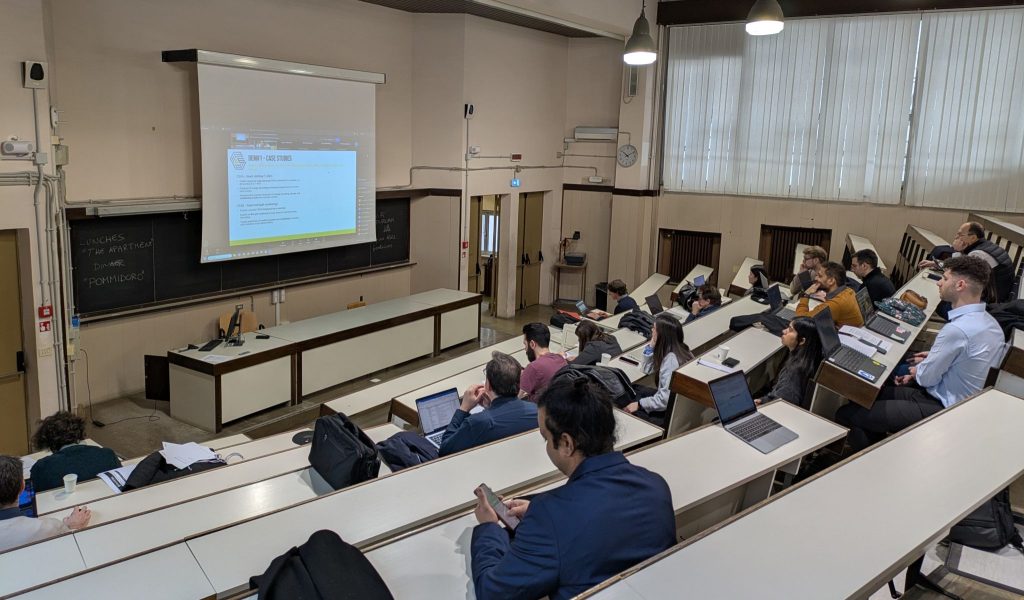
The GRAPHERGIA’S Demo Cases Technical Discussions
On the first day of the meeting, we concentrated on in-depth technical discussions concerning our demonstration cases.
For Demo Case 1. ‘All-in-one self-charging textile capable of both energy harvesting and storage’, led by Born – Knitting Engineers and Adamant Composites, our work is centred on three case studies: a T-shirt, a belt, and a smart seat. Next Technology Tecnotessile (NTT) is responsible for the eco-design analysis and the optimisation of key parameters across the three demos. The key technical partners involved in this demo are:
- Foundation for Research and Technology – Hellas (FORTH) and Adamant handle the fabrication of conductive electrodes.
- NTT and FORTH are responsible for the deposition of polymers as energy harvesting layers (adhesion on graphene-coated textiles and fibers, enhanced and lasting tribo-electric nanogenerators (TENGs) effect, durability and washability).
- Université Gustave Eiffel (UGE) leads the TENGs implementation, including configuration and power requirements, since TENG structures will be embedded in the T-shirt for energy harvesting/storage, on the belt for online gait monitoring, and on the seat.
- FORTH, DLR and Born manage the fabrication of solid-state, interdigitated micro-flexible supercapacitors, and UGE is involved in matching with the TENGs.
- Comsensus is responsible for the signal processing, and NTT for the product evaluation for thermo-physiological comfort.
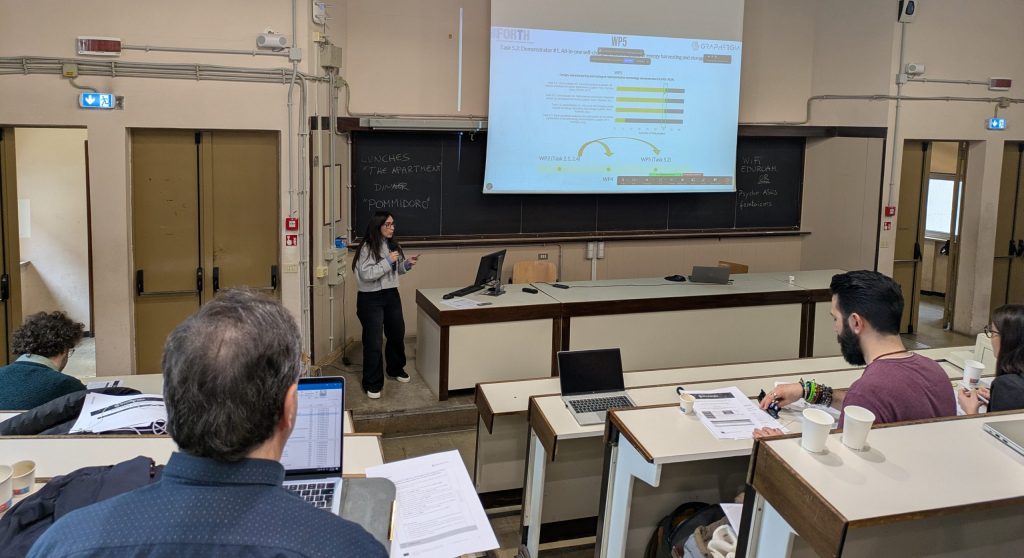
Regarding the Demo Case 2. ‘Self-powered structurally integrated sensor for aerospace structures’, led by Adamant Composites, a miniaturised TENG-based self-powered wireless sensor integrated in a scaled aerospace composites structure will be demonstrated. A self-powered wireless temperature/strain sensor integrated in the composite fan blade will enable more accurate data, leading to faster and better design, and the TENG device will be embedded in the carbon and/or glass fiber laminated composite materials.
The tasks required to demonstrate this case are as follows:
- Laser-assisted fabrication of an interdigitated strain/temperature sensor interfaced to the TENG for energy harvesting and to solid-state, micro-flexible supercapacitor for energy storage (FORTH, Adamant, DLR).
- Integral power management system design (UGE).
- Manufacturing trials on carbon fabric substrates using roll-to-roll laser pilot line (Adamant, FORTH, NTT).
- Signal processing (Comsensus).
The final goal is to deliver a prototype flexible strain/temperature sensor with integrated energy supply, thickness like standard composite lamina thickness, and capability to wireless transmit the generated data when integrated in a Carbon-Fiber-Reinforced Polymer (CFRP) material. The successful integration will be confirmed through structural analysis of the composite component and the manufacture of a scaled, simplified CFRP structure. This application provides aircraft operators with real-time information to help them make informed maintenance decisions.
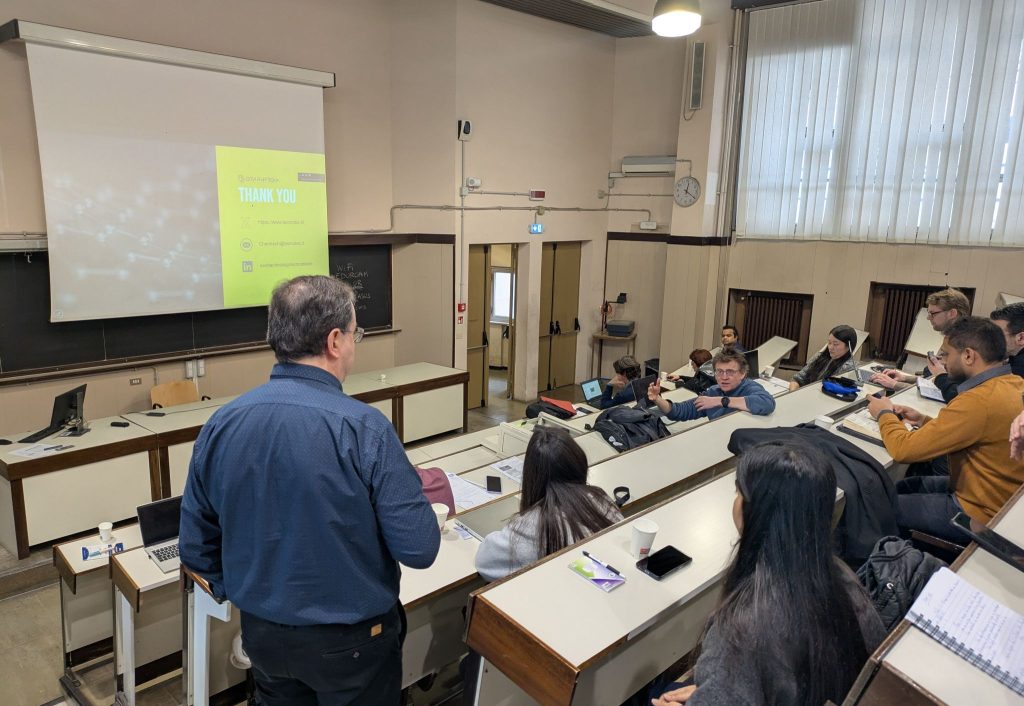
Last, but not least, the Demo Case 3. ‘Advanced graphene-based LIB module prototype for space applications’ focuses on a module prototype that will be designed, manufactured and tested to validate the capabilities and advances of the developed laser-assisted fabrication technology at TRL 5 (Technology Readiness Level) on the system level based on the optimal laser-scribed graphene-based electrodes and LIB cells.
The partners involved are FORTH, Pleione Energy, Adamant Composites and NTT, who, together will work on the laser-scribed graphene-based electrodes and LIB cells (FORTH); design, manufacturing, and validation of a module prototype in real-world environment (Pleione); design of the pack and definition of the cell configuration (Pleione); development of hard casing pouch cells (Pleione, Adamant); and performance tests of the battery module, including standard capacity measurement, Galvanostatic Charge-Discharge (GCD) cycling, and increased current density cycling based on an operating profile for low earth orbit applications (Pleione, FORTH).
The GRAPHERGIA Sustainable Methodology
Eco-design is a central principle of GRAPHERGIA. In fact, we have a Work Package (WP) entirely dedicated to it: WP6 – ‘Life cycle assessment, sustainability and eco-design approach’, led by NTT, and our methodology is in line with the European Commission “Sustainable product policy and eco-design”.
As part of the agenda for the meeting, our partners also reflected on the Life Cycle Assessment (LCA) analysis and the environmental impact, but also on the cost-benefits, and the best value across the asset life cycle model. Matteo Maccanti, LCA Analyst at NTT, also presented the results of the Social Life Cycle Assessment inventory tailored on real data, collected directly from the field of application through customised surveys. He remarked the importance of gathering preferences on new materials/processes/products, as well as to design a strategy to boost job creation and stakeholder and consumer acceptance for the new products developed by our innovators.
The GRAPHERGIA Communication and Dissemination Strategy
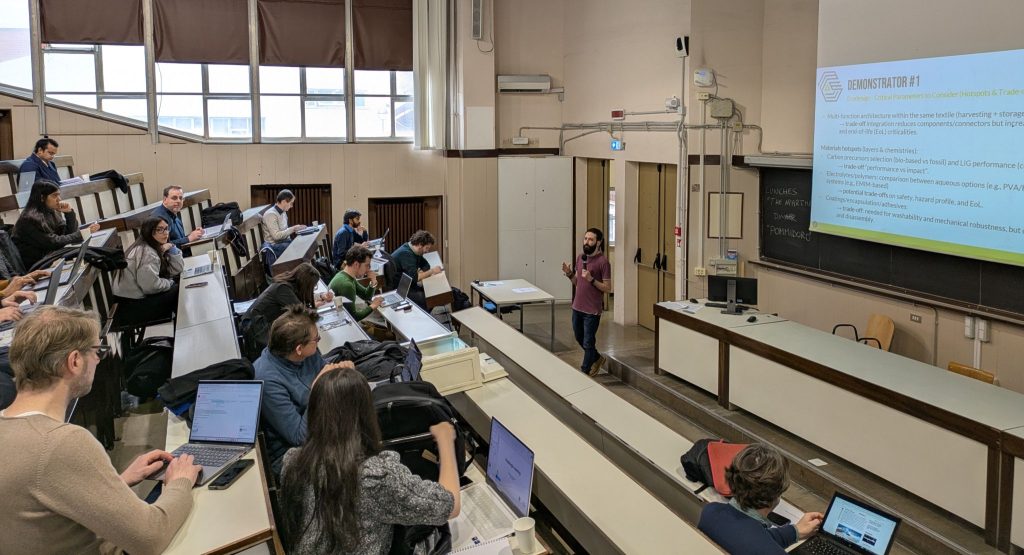
In our fourth general assembly in Rome, we also had time to think about our communication and dissemination strategy for the last year of GRAPHERGIA. We will focus on explaining the impact on society of our demo cases, highlighting our Key Exploitable Results (KERs) and its relation to each demo case.
We won’t forget about the team behind GRAPHERGIA, and we will keep featuring our young researchers through interviews to explain their role in our project. Scientific publications, participation in events, our new podcast series “The Human Side of Graphene”, and the GRAPHERGIA Hub webinars will also be a key pillar part of our dissemination plan.
In fact, you can already listen to our first podcast episode “Smart Materials, Smarter Medicine: Graphene Biosensors in Healthcare” on Spotify, or watch it on YouTube:
A warm thank you to Tullio and his team at Sapienza Università di Roma for hosting us!