

GRAPHERGIA continues to disseminate its research on high-performance flexible electronics and e-textiles. This time, with a new scientific publication.
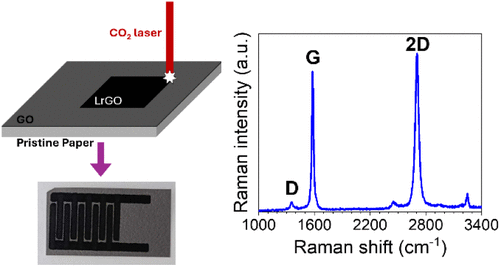
In the framework of the project, the research team from the Foundation for Research and Technology Hellas (FORTH) has published a new scientific article in a scientific journal. This article, “Laser-Reduced Graphene Oxide with Ultralow Defect Density for Paper-Supported Electrochemical Capacitors”, was published in open access in the scientific journal ACS Omega 2026 on the 17th of February 2026, in the Volume 11 / Issue 8.
GRAPHERGIA’s Scientific Paper Abstract
Laser-assisted reduction of graphene oxide (GO) has emerged as a promising method for fabricating conductive films and interdigitated electrodes onto flexible substrates, paving the way for high-performance flexible electronics and smart textiles. In this study, we demonstrate laser-reduced graphene oxide (LrGO) with an unprecedent-edly low defect density (average D/G Raman band ratio of 0.1) onto bare heat-sensitive paper substrates. Under optimal lasing conditions, the paper-supported LrGO films exhibit a very low sheet resistance (<50 Ohm sq−1) and maintain good conductivity after multiple cycles of bending deformation. Increasing the laser power beyond the threshold required for GO reduction leads to a gradual decrease in defect density (as measured by Raman spectroscopy), while the surface chemistry (analyzed via X-ray Photoelectron Spectroscopy) remains largely unaffected. This suggests that excess photon energy primarily contributes to defect healing rather than further extending the reduction of LrGO. Three-electrode characterization in a 6 M KOH electrolyte revealed a maximum capacitance of 31.8 mF cm−2 at 10 mV s−1, while the capacitance of an interdigitated supercapacitor with PVA:H2SO4 electrolyte was 5.2 mF cm−2 at 0.02 mA cm−2. These values surpass those reported in recent studies on symmetric supercapacitors using LrGO electrodes on protected paper and other polymeric substrates, underlining the superior quality and potential of the electrodes developed in this work.
About the Authors
This publication was authored by researchers from GRAPHERGIA’s coordinator organisation, Foundation for Research and Technology Hellas, Institute of Chemical Engineering Sciences (FORTH/ICE-HT):
- Nikolaos Samartzis
- Elli Bellou
- Michail Athanasiou
- Labrini Sygellou
- Spyros N. Yannopoulos
Read and download the entire scientific article on GRAPHERGIA’s Zenodo!